


Quora: the knowledge platform
Quora, Inc.
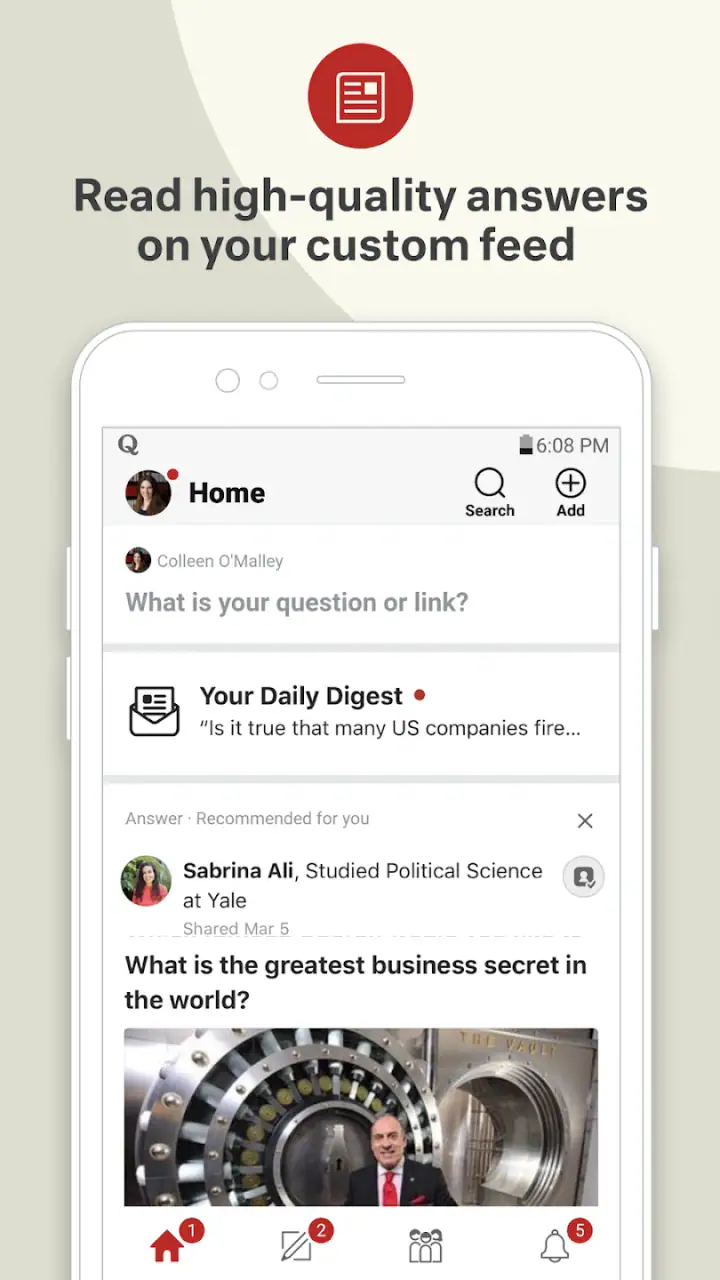
I approached Quora as a place to find explanations rather than quick headlines, and that distinction matters from the first minute. It is a free News & Magazines app from Quora, Inc., but its real character comes from questions and answers written around them. Instead of opening to a simple stream of finished news stories, you enter a large conversation where people ask about science, work, culture, technology, health, history, and everyday decisions.
That format can be surprisingly useful when I have a specific question that is too practical, personal, or open-ended for a standard news article. It can also become noisy if I browse without a purpose. My experience was best when I treated the app as a research starting point and a way to compare viewpoints, not as a replacement for specialist advice or carefully edited journalism.
What to expect when you open Quora
The first thing to understand is that Quora is built around curiosity. The useful unit is not an article category but a question: why something works, how another person handled a situation, what a term means, or which factors should be considered before making a choice. Answers can be short and direct, or they can develop into long personal explanations with examples and qualifications.
The app’s store summary describes it as a place to share knowledge and better understand the world, and I think that is a fair description as long as you remember that the quality of the knowledge varies. A thoughtful answer can make a complicated subject approachable. A confident answer can still be incomplete, outdated, or based mainly on one person’s experience.
Quora has a 4.1 average from around one million ratings and has passed fifty million installs, so it is clearly a familiar destination for people who enjoy question-and-answer browsing. Those figures tell me that the service has broad reach, not that every answer deserves equal trust. I still check the author’s reasoning, look for supporting detail, and compare important claims elsewhere.
Related News

Why WhatsApp Messenger Still Makes Everyday Communication Feel Easy

Jurassic World: The Game Is the Better Dino Tycoon for Strategic Players

Threads in Real Life: Who Should Join, Lurk, or Leave

How SHEIN Turned Shopping Into an Endless Content Feed

How to Make Fortnite Feel Smarter on Mobile

Should You Switch to Microsoft Outlook on Mobile?
As a News & Magazines app, it sits somewhere between a discussion community, a reference shelf, and a personalized reading feed. That makes it more flexible than a conventional newsreader, but also less predictable. If you want a list of verified headlines with consistent editorial standards, a dedicated news app is usually a better fit. If you want to see how different people explain a subject, Quora offers a more human and sometimes more revealing experience.
The best reason to use it
I find the app most valuable when I begin with a real question. For example, imagine that I am preparing for a job interview in a field I do not know well. A search for broad background information may give me definitions, while Quora can expose the practical questions people ask about that career: what beginners misunderstand, which skills are actually used, and what daily work feels like. I would not treat those answers as a final authority, but they can help me form better questions before reading formal sources.
The same approach works for travel planning, learning a technical concept, understanding a historical event, or comparing different ways to solve a personal problem. The strongest answers often include context that a short search result leaves out. The trade-off is that you must spend time separating careful explanations from attractive storytelling.
Gallery
Who will enjoy it, and who may not
Quora is a good match for readers who like following a question into several perspectives. It suits people who learn through examples, enjoy long-form answers, or want to discover subjects they would not normally search for. It can also help writers and students notice which explanations are clear and which details readers repeatedly find confusing.
I would be more cautious recommending it to someone who wants fast, uniformly edited news. The feed can lead you from a useful answer into unrelated topics, and the personal tone of many responses may feel too subjective. Readers who dislike scrolling through several answers to find a reliable one may prefer a traditional magazine app or a focused reference source.
Getting started without making the feed noisy
Quora is available at no charge, carries a Teen content rating, and supports devices running Android 7.0 or later. The current Android version is 3.2.34. Those details make it approachable for many users, but the more important setup decision is not technical: it is deciding what you want from the app before the feed begins shaping your attention.
On first launch, I would avoid selecting every topic that sounds vaguely interesting. A narrow starting point produces a more useful first session. Choose a few subjects connected to something you genuinely want to understand, such as cooking techniques, personal finance basics, programming, books, or a professional field. When the app presents a topic that does not interest you, treating that as a signal to refine your interests is better than simply continuing to scroll.
If you are creating or using an account, take a moment to make your profile reflect the subjects you can discuss honestly. You do not need to present yourself as an expert in everything. A modest profile can make your contributions feel more credible because readers can understand the perspective behind an answer. I also recommend reading quietly at first. Two or three sessions spent observing how questions are phrased will make your own participation much easier.
One useful habit is to save a question mentally before opening the app. “I want to understand the difference between these two ideas” is a better starting point than “I wonder what is in the feed.” The first goal gives you a way to judge the session. The second can turn into passive browsing, where interesting material accumulates without helping you do anything.
How I judge an answer before trusting it
I look for answers that define their terms, explain the reasoning, and acknowledge limits. A response that says “it depends” is not automatically weak; sometimes the conditions are the most important part. On the other hand, a long answer full of certainty and personal anecdotes may be less useful than a shorter response that clearly separates experience from evidence.
When several answers address the same question, I compare their assumptions rather than simply counting agreement. If one person describes a personal result and another explains a general principle, they may not actually be contradicting each other. This is one of the app’s less obvious learning opportunities: disagreement can reveal which part of a question needs to be made more precise.
For health, legal, financial, or safety-related decisions, I use Quora only to learn vocabulary and identify issues worth investigating. I would not use an anonymous or informal answer as the sole basis for an important decision. That is not a flaw unique to this app; it is a necessary boundary for any open discussion platform.
Finding the first meaningful success
The easiest way to get value from Quora is to complete one small task: search for a question you genuinely have, read several answers, and write down one idea that changes what you will do next. That final step matters. Without it, the app can feel informative while producing no practical result.
For a realistic example, suppose I am choosing between two ways to learn a language. I could ask a broad question, then compare answers from people who describe different schedules, goals, and levels of experience. I would note which recommendations depend on having a teacher, limited time, or a particular reason for learning. My successful outcome would not be finding one universal method; it would be identifying a plan that matches my circumstances and knowing what to test first.
Asking a question can be even more useful, but I would make it specific. “How do I become better at writing?” invites general advice. “How can I make the explanations in my short product reviews clearer without making them longer?” gives people something concrete to address. Include what you have already tried and what constraint you face. The quality of responses often improves when the question makes the real problem visible.
Before posting, I would search for similar questions. This avoids repeating a common request and may reveal a detailed answer immediately. It also teaches you the vocabulary used by the community around that subject. A good search is not just a shortcut; it is preparation for asking a question that adds something new.
Reading and participating without losing your time
The feed is tempting because every answer can lead to another subject. I manage that by opening the app with a time limit or a single question in mind. When I find an answer worth keeping, I copy its key idea into my own notes rather than assuming I will remember it later. This simple workflow turns browsing into a small research session.
I also separate discovery from verification. Quora is excellent for discovering the questions people ask and the practical terms they use. After that, I move to books, official documentation, professional publications, or other reliable sources when accuracy matters. This two-stage method preserves the app’s human perspective without giving informal claims more authority than they deserve.
Another useful technique is to read the comments and follow-up discussion carefully, but not automatically treat the most popular reaction as the best correction. Follow-ups can expose missing assumptions, yet they can also become arguments. I look for comments that add a concrete example, correct a specific point, or ask for a source. Those are more valuable than simple approval or dismissal.
Common confusion for new users
The biggest misunderstanding is expecting Quora to behave like a conventional magazine. Its subject areas may resemble a news and reading service, but the content is organized around questions and contributors. That means the same topic can appear through personal stories, explanations, debates, recommendations, and speculative answers. The variety is the attraction, but it makes your own judgment part of the reading experience.
Another point of confusion is the difference between a persuasive answer and a well-supported one. Clear writing can create an impression of expertise, especially when the author uses technical language or tells a compelling story. I try to ask what the answer actually demonstrates, whether it explains a limitation, and whether another qualified source would likely agree.
New users may also wonder why a question keeps producing answers that do not match their situation. Usually the question is too broad, or the writers are answering a slightly different version of it. Adding location, experience level, budget, time available, or the result you want can dramatically improve relevance. Specific context is not unnecessary detail; it is what prevents generic advice.
There is also a practical difference between reading anonymously and participating openly. Reading lets me explore unfamiliar subjects with little commitment. Writing makes me responsible for the clarity and limits of what I say. If I answer, I avoid presenting a personal outcome as a general rule, and I state when my experience is narrow. That approach tends to produce more useful discussion and keeps expectations realistic.
How it compares with other ways to learn
Compared with a standard news app, Quora is less consistent in tone and editorial control but more likely to show personal reasoning and unusual questions. Compared with a search engine, it can offer a sustained explanation instead of isolated snippets, although search results often make it easier to reach primary or official sources. Compared with a discussion forum, Quora usually gives the question a more central role, which can make useful answers easier to follow even when many people contribute.
Compared with a social network built mainly around short posts, the app rewards patience more than instant reaction. I can learn from an answer’s structure and examples, not just from a headline or a quick opinion. Still, it shares the general risk of any large community: popularity and usefulness do not always move together.
For a student doing formal research, I would use Quora to discover angles and terminology, then cite dependable original material instead. For someone deciding how to approach an everyday problem, the app may be more immediately helpful because personal experience can reveal practical obstacles. For breaking news, I would choose a dedicated news source first and use Quora later to explore public questions and interpretations.
What to do after the first useful session
Once I have found a few subjects that consistently help me, I refine the topics rather than following everything that appears. I look for questions with specific wording, compare several answers, and keep a small list of sources or ideas that deserve further checking. This makes the app feel less like an endless feed and more like a personal shelf of starting points.
I would also try answering one question only when I can add a concrete example or a clearly explained perspective. A short, honest answer is better than a confident essay that says little. If the question is outside my experience, I skip it. Quora becomes more valuable when participation improves the conversation instead of adding another vague opinion.
My final view is positive but measured. Quora is free, easy to approach, and unusually good at showing how people frame real questions. Its large community gives it breadth, while its open-answer format creates uneven quality. Use it as a guided starting point, not as an automatic authority. If you enter with one question, read critically, and follow important claims to stronger sources, it can become a genuinely useful companion for learning and everyday decisions. If you want polished, verified news with minimal judgment required, another app will serve you better.
FAQs for Quora: the knowledge platform
What is Quora and how does it work?
Quora is a knowledge-sharing platform where users can ask questions and receive answers from the community. It operates on a question-and-answer format, allowing users to follow topics of interest, upvote helpful answers, and engage with experts. The app is designed to foster informative discussions and provide diverse perspectives on various subjects.
Is Quora free to use, and are there any hidden costs?
Quora is free to download and use, offering a broad range of features at no cost. However, it offers a premium subscription called Quora+, which provides access to exclusive content and ad-free browsing. Users can choose to pay for this service, but it is entirely optional and not required for basic use.
How does Quora ensure the accuracy of the information provided?
Quora relies on its community to maintain accuracy. Users can upvote or downvote answers, which helps surface the most reliable responses. Additionally, experts in various fields often contribute, enhancing the quality of information. However, users should cross-check facts as the platform is community-driven and not all answers are vetted.
Can I use Quora without creating an account?
While you can browse questions and answers without an account, creating one allows for a personalized experience. With an account, you can follow topics, ask questions, contribute answers, and interact with other users. Signing up is straightforward and can be done using an email address or social media integration.
What privacy measures does Quora have in place?
Quora takes user privacy seriously, offering several controls to manage your information. You can choose what personal details to share, and there are options to write anonymously if desired. The platform also has a comprehensive privacy policy detailing how user data is handled, ensuring transparency about information usage.
Pros
- Wide range of topics covered effectively.
- User-friendly interface for easy navigation.
- High-quality content from credible sources.
- Engaging community with diverse perspectives.
- Customizable feed to suit personal interests.
Cons
- Ads can be intrusive for free users.
- Notifications can become overwhelming.
- Some answers lack depth or accuracy.
- Limited offline reading options.
- Occasional duplicate questions clutter feed.


